
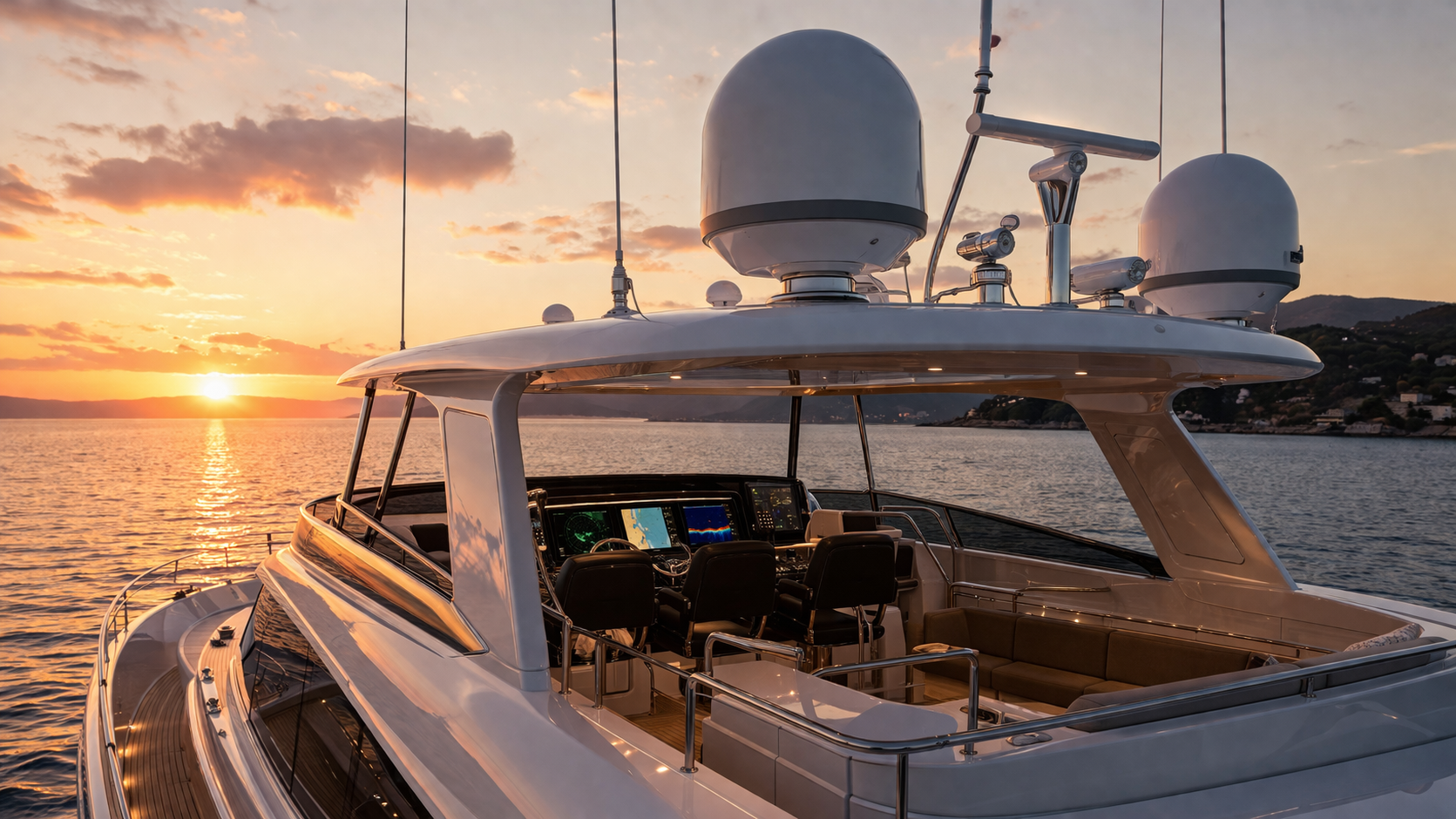
Starlink Maritime vs. KVH for Yachts: Speed Is Only Half the Decision
Yacht connectivity is usually misjudged for the same reason helm refits are: buyers focus on the most visible specification first. In this category, that is speed. But offshore, speed is only one layer of the problem. The harder questions arrive later—when the boat shifts from marina Wi‑Fi to cellular, from cellular to satellite, from coastal to international waters, or from a simple owner-operated profile to a vessel that expects real uptime, support, and predictable behavior across changing routes. That is where “fast internet” stops being a consumer purchase and starts becoming a systems decision. (Starlink)
The first point of clarity is that this is not always a clean brand-versus-brand comparison. KVH’s current leisure-marine positioning explicitly includes LEO options such as Starlink, alongside satellite, cellular, and Wi‑Fi through the KVH ONE hybrid network. KVH also frames its leisure-marine offer around a single point of contact for onboard communications and entertainment. In practice, that means many yacht owners are not choosing between “Starlink” and “KVH” in the abstract. They are choosing between direct Starlink service and a managed KVH architecture that may include Starlink as one layer of the stack. (KVH Industries)
Where direct Starlink is strongest
Starlink’s proposition is straightforward, and that simplicity is part of its appeal. Starlink’s Business Maritime page says the service provides connectivity on Earth’s oceans and waterways, including coverage in international waters. Starlink’s own support materials also define Starlink Maritime as the use of Global Priority plans on the ocean. For an owner who wants a more direct, performance-led path into onboard internet, that is a compelling value proposition: broad coverage, a relatively simple procurement model, and a brand that has made low-latency satellite connectivity part of the mainstream marine conversation. (Starlink)
Starlink has also made its product ladder more nuanced than many buyers realize. Its Roam materials say you can use a Roam plan on a boat in coastal and inland waters, and for international waters you can enable Ocean Mode. Starlink also says that for frequent or extended ocean travel, customers should look at Maritime instead. That matters because it separates three very different use cases: occasional coastal boating, intermittent international-water use, and a vessel that genuinely intends to operate offshore as a matter of routine. Those are not the same operational profile, and Starlink’s own plan language now reflects that. (Starlink)
There is, however, an important compliance nuance that luxury buyers should not ignore. Starlink’s support language on Global Priority limitations says maritime use in coastal waters should only occur in territorial waters where licensing is held by SpaceX or by the end user. Starlink also distinguishes Local Priority from Global Priority, stating that Local Priority is intended for inland coverage and not for global or ocean use. In other words, the service model is not just about buying the fastest plan available. It is also about where the vessel will be used, under which plan type, and under what licensing assumptions. (Starlink)
That is the real strength of direct Starlink: it is the cleanest answer when the owner values straightforward acquisition, strong global brand recognition, and a direct path to ocean-capable service through Global Priority. But it is not automatically the most complete answer for every yacht. That conclusion is an inference from Starlink’s plan segmentation and usage limitations, rather than a quoted manufacturer claim. (Starlink)
Where KVH changes the buying equation
KVH becomes more persuasive when the owner’s question shifts from raw connectivity to managed connectivity.
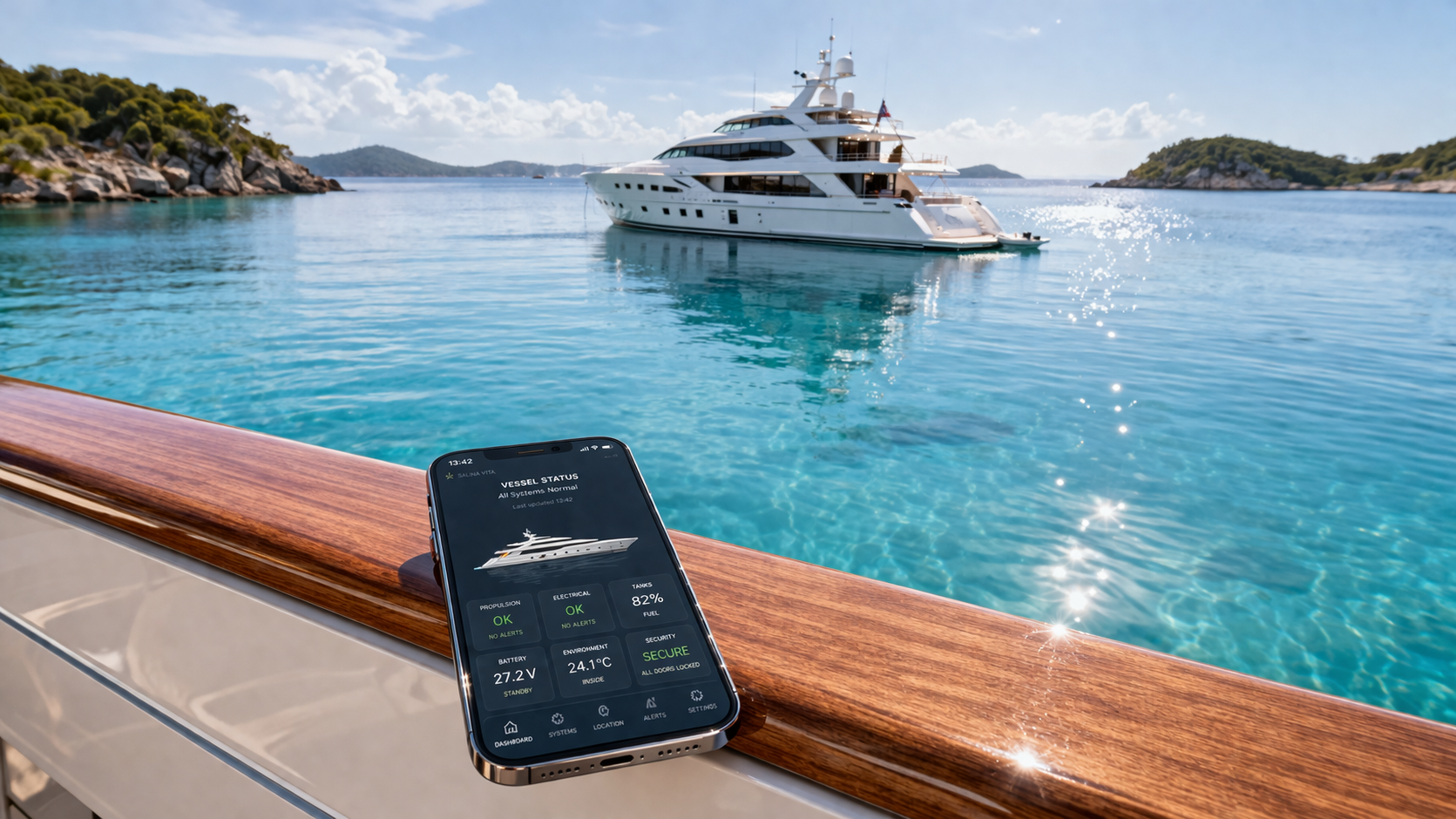
The company’s current TracNet H30 positioning is explicit: the terminal combines satellite, cellular, and Wi‑Fi in one ultra-compact system with intelligent, automatic network switching. KVH’s launch material goes further, stating that switching is based on availability, cost, and connection quality, and that subscribers can access integrated 5G/LTE support in 150+ countries. That is not just a hardware feature. It is a philosophy of continuity. The point is not simply to connect the boat offshore; it is to keep the vessel on the best available path as conditions and geography change. (KVH Industries)
That difference is subtle but decisive. Direct Starlink is often a bandwidth-first purchase. KVH is closer to a network-orchestration purchase. A TracNet installation is designed to move between shore-based Wi‑Fi, cellular, and satellite rather than treating satellite as the only meaningful layer. For yachts that spend real time near marinas, move across coastal regions, or want a cleaner transition between dockside and offshore behavior, that hybrid logic can matter as much as peak throughput. That is an inference from KVH’s hybrid-network positioning and switching model. (KVH Industries)
KVH also competes on support in a way that many owner-operators underestimate until something goes wrong. KVH’s support center says 24/7/365 support is available for KVH’s Starlink customers, and KVH’s OneCare program is positioned around global service and support for connectivity solutions. Combined with KVH’s leisure-marine framing of itself as a single point of contact, the buying experience becomes materially different from a pure self-managed service relationship. The customer is no longer only buying terminal performance. They are buying a service layer that is meant to protect uptime and simplify problem resolution. (KVH Industries)
That is why the real expert comparison is not “Which one is faster?” The more useful question is, “Do you want to own the connectivity stack directly, or do you want a managed hybrid architecture with a support organization wrapped around it?” For a smaller, owner-operated yacht with a simpler route profile, those may look similar. For a vessel that crosses boundaries often, expects graceful failover between networks, or treats connectivity as part of the yacht’s operating standard rather than a convenience, they are not similar at all. That conclusion is an inference from the plan and support structures above. (Starlink)
How we would think about the decision
For a yacht that stays mostly within coastal and inland use, or one where the owner is comfortable managing service choices more directly, Starlink can be a very rational first answer. The product ladder now clearly distinguishes Roam, Ocean Mode, and Maritime, so the owner can align the service level to actual water use rather than guessing. (Starlink)
For a yacht that regularly moves between marina Wi‑Fi, near-shore cellular, and offshore satellite—or where the owner values one managed provider relationship more than a pure direct-service model—KVH becomes much more compelling. The presence of Starlink inside KVH’s broader leisure-marine and support ecosystem is especially important here, because it means the buyer may not have to choose between modern LEO performance and managed hybrid resilience. In many cases, the more refined answer is not “Starlink or KVH.” It is Starlink through a better service architecture. That is an inference, but it is consistent with KVH’s published positioning. (KVH Industries)
For larger yachts, charters, or owners who regard internet access as operational infrastructure rather than lifestyle convenience, support discipline rises in importance very quickly. Once connectivity touches guest expectations, work continuity, onboard services, and route flexibility, the procurement conversation should widen beyond speed and monthly price. The deciding factors become support access, switching logic, hardware footprint, and whether the vessel wants a direct-service mindset or a managed-service mindset. That framing is an inference from how Starlink and KVH currently present their products and service layers. (Starlink)
What we would recommend at Salina Vita
We would not start with a speed test. We would start with the itinerary.
How often does the boat leave territorial waters? How much time does it spend near marinas and cellular coverage? Is the owner comfortable managing service directly, or does the vessel need a more concierge-grade support structure? Is the priority raw bandwidth, graceful network switching, one point of contact, or a balance of all three? Those questions determine the right architecture far more reliably than a headline throughput number ever will. That is the difference between buying internet and specifying connectivity. (Starlink)
The quiet luxury of a well-specified yacht is that the systems disappear into confidence. Connectivity should feel the same way. The best setup is not the one with the flashiest specification sheet. It is the one that behaves correctly at the dock, along the coast, and offshore—without forcing the owner to think about it more than necessary. (Starlink)
Share:
Built-In Sonar or Black-Box CHIRP? Offshore Fishfinding Guide
Open-Array vs. Radome Radar for Yachts