
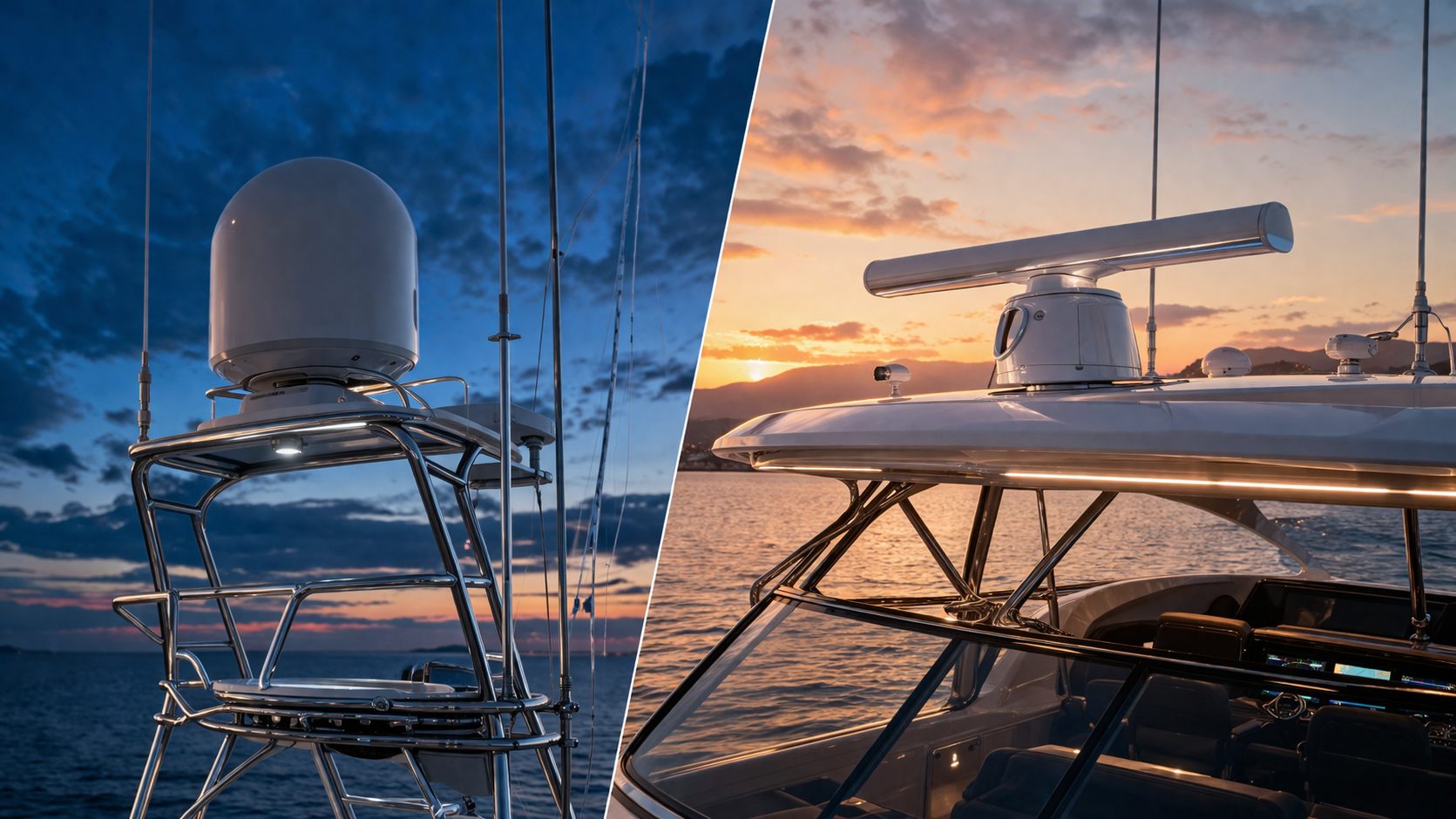
Open-Array vs. Radome Radar for Yachts: Choose by Mission, Not by Antenna Size
Radar selection is often framed as a question of size. On a serious yacht, that is usually the wrong starting point. The real decision begins with the vessel’s operating profile, the available mounting envelope, the power budget, and the kind of targets the helm must interpret quickly—traffic in a crowded inlet, small contacts near structure, distant weather, or birds working over bait offshore. Raymarine’s own guidance makes the distinction clearly: radomes are intended for boats where space is limited, while open arrays demand more topside room and weight capacity but deliver significant gains in range, performance, and capability. (Raymarine)
A radome is not the “less serious” option
Modern radomes are better than many owners assume. Raymarine’s Quantum 2 is an 18-inch solid-state CHIRP pulse-compression radome with Doppler collision-avoidance technology. Raymarine says it is ideal for sailboats, RIBs, and smaller powerboats, offers a minimum range of 6 meters, a maximum range of 24 nautical miles, Wi‑Fi and Ethernet connectivity, 12/24 V operation, a 5.6 kg weight, and low transmit power draw. Those are not merely convenience specifications; they explain why a premium radome can be the cleanest solution when the goal is a lighter, simpler, lower-profile installation that still preserves modern situational awareness. (Raymarine)
Furuno’s DRS4D‑NXT makes the same case from a different angle. It is a 24-inch solid-state Doppler radome rated at 25 watts and 48 nautical miles, and Furuno pairs it with Target Analyzer, Fast Target Tracking, Bird Mode, and RezBoost beam sharpening. Furuno says Target Analyzer automatically colorizes approaching targets red and stationary or receding targets green, while Fast Target Tracking displays course and speed vectors in seconds; it also says RezBoost can sharpen the presentation to the equivalent of a 2-degree beam. In practical terms, that means a high-end radome is no longer a compromise for every yacht—it can be a very capable primary radar when the boat’s size, roofline, and mission favor compactness over maximum antenna span. (Furuno USA)
Open array earns its place when performance is the priority
Open-array radars justify their visual footprint because the antenna itself changes what the radar can do. Raymarine’s guide explains that longer open-array antennas increase sensitivity to weak echoes, focus microwave energy more tightly, extend effective range, and produce a cleaner picture of small contacts that are close together or of complex shoreline detail. The same guide also notes the tradeoff: open arrays are considerably heavier than radomes and require much more topside space. That is the real balance a yacht owner is making—not elegance versus utility, but installation burden versus measurable performance. (Raymarine)
Raymarine’s current open-array lineup shows how wide that performance ladder now is. Cyclone is offered in 3-, 4-, and 6-foot configurations and supports Doppler target tracking, while Magnum remains the company’s magnetron-based open-array platform with 4 kW or 12 kW transmitters, 4- or 6-foot arrays, and a maximum stated range of up to 96 nautical miles on 12 kW models. Raymarine’s own positioning places these systems squarely in the realm of serious powerboats, fishing boats, motor yachts, and other vessels where longer-range detection and sharper target separation matter enough to warrant the installation. (Raymarine)
Furuno’s open-array NXT family makes the same performance ladder even more explicit. The DRS6A‑NXT is a 25-watt open-array system available with 3.5-, 4-, or 6-foot antennas, with beam widths narrowing from 2.3° to 1.35° and a stated range of 72 nautical miles. The DRS12A‑NXT steps up to 100 watts and 96 nautical miles, while the DRS25A‑NXT moves to 200 watts, the same 1.35°/1.9°/2.3° beam-width options depending on antenna length, and 24 VDC power. Furuno also carries forward the same NXT features—Target Analyzer, Fast Target Tracking, Bird Mode, and RezBoost—into these larger arrays. In other words, the upgrade from dome to open array is not cosmetic; it buys narrower beams, longer reach, and more authority over the radar picture. (Furuno USA)
Fishing and bird work change the calculation
For offshore fishing boats and sportfish platforms, bird finding is where open arrays often pull decisively ahead. Raymarine says all marine radar can detect birds to some degree, but open-array antennas have a narrower beam and greater receive aperture, which improves sensitivity to small, weak aerial targets. Raymarine also says Bird Mode is standard on Cyclone and Magnum open arrays, and it specifically notes that Magnum’s higher power and larger 4- and 6-foot arrays make it especially well suited to bird finding. Furuno’s NXT family also includes Bird Mode, which automatically adjusts gain and sea settings for better visibility of birds working the surface. That combination of tighter beam geometry, higher power, and fish-specific operating modes is exactly why many offshore captains still regard open arrays as worth the extra weight aloft. (Raymarine)
Doppler and tracking matter in traffic, not just offshore
The most useful radar features for yacht owners are often the ones that reduce interpretation time rather than simply extend maximum range. Raymarine says Doppler target tracking is available on Quantum 2 radomes and Cyclone open arrays, colorizing inbound contacts red and outbound contacts green. On Quantum 2, Raymarine also recommends adding a heading sensor because it improves low-speed performance, MARPA/ARPA target tracking, and stabilized radar/chart overlay. Furuno’s Target Analyzer uses a similar red/green logic for approaching and non-threatening targets, and its Fast Target Tracking adds course and speed vectors within seconds. Those are the kinds of features that materially change helm workload in crowded harbors, poor visibility, or busy coastal traffic lanes. (Raymarine)
So which radar belongs on which yacht?
For a yacht whose priorities are a clean hardtop, lower weight aloft, easier installation, and strong coastal or near-offshore awareness, a premium solid-state radome often makes the most sense. That is especially true when the owner wants Doppler awareness and modern short-range performance without committing major topside space to an array. For larger motor yachts, sportfish platforms, and vessels that value sharper separation, greater long-range authority, or stronger bird-finding performance, open array usually earns its place. That recommendation is an inference from the manufacturers’ published use cases, beam-width data, power options, and bird-finding guidance—not a one-size-fits-all rule, but a very useful one. (Raymarine)
At Salina Vita, we would not begin with the scanner you like the look of. We would begin with mounting height, hardtop structure, power availability, traffic profile, expected offshore range, and whether the boat needs a cleaner luxury roofline or a more aggressive performance envelope. The right radar is the one that fits the vessel’s mission so well that, once it is installed, the helm simply feels calmer and more certain. That is what premium marine electronics are supposed to do.
Share:
Starlink Maritime vs. KVH for Yachts
Best Autopilot for an Outboard Center Console?