
Off-Grid Grace: The Monitoring Stack That Lets You Stay Longer in Remote Anchorages
The most satisfying anchorages do not feel busy. They feel removed—quiet water, minimal traffic, and the sense that the yacht has stepped beyond routine. But the ability to stay longer in places like that is rarely a matter of scenery alone. It depends on whether the vessel’s essential systems can be watched discreetly, responded to intelligently, and trusted without constant supervision.
That is what off-grid grace really means. Not more screens. Not more notifications. A calmer technical standard beneath the experience of being far from the dock.
Connectivity is the first layer, not the final answer
For a yacht intended to spend real time away from marinas, the first requirement is not entertainment bandwidth. It is resilient onboard connectivity. Raymarine positions YachtSense Link as a marine mobile router with Raynet Ethernet, mobile broadband, and onboard Wi‑Fi, designed to connect Axiom displays, phones, tablets, and PCs to one onboard network. Raymarine also says the router automatically switches between marina Wi‑Fi and mobile networks, supports dual SIM cards, includes GPS, and can provide remote connection to NMEA 2000 devices plus geofencing. In Raymarine’s current learning material, YachtSense Link is also framed as the onboard router that can unify dock Wi‑Fi, 4G LTE from up to two carriers, and satellite internet via WAN port, such as Starlink. (Raymarine)
That matters because remote-anchorages are rarely a binary environment of “online” or “offline.” They are transitional. A yacht may move from dockside Wi‑Fi to coastal cellular, then to a satellite-backed network path, all within the same cruise. The value of a serious router is not only that it keeps the boat connected, but that it reduces the amount of human intervention required to stay that way. That is an inference from Raymarine’s switching, dual-SIM, and unified-network design. (Raymarine)
The phone should extend the helm, not replace it
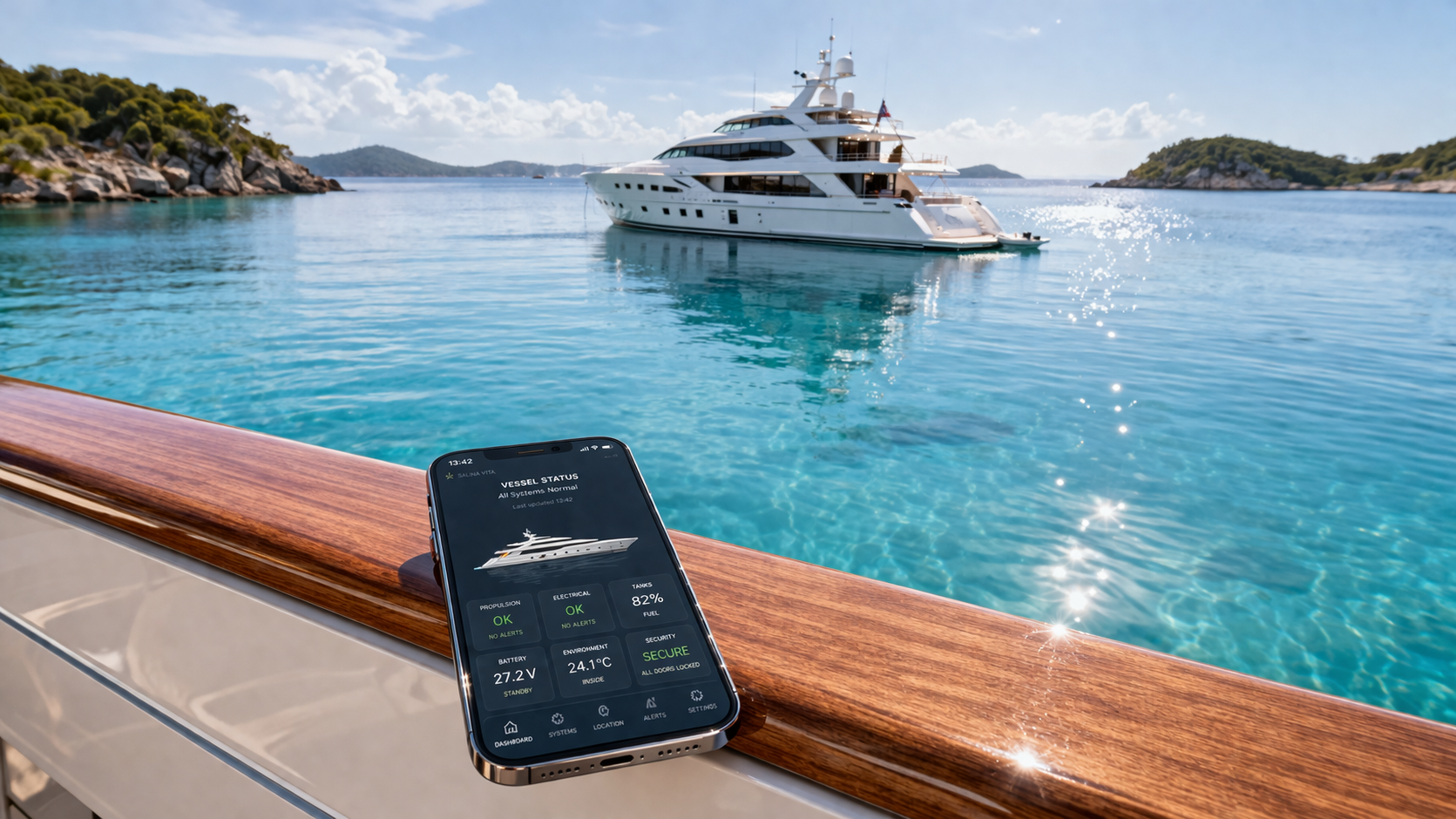
A refined remote-monitoring stack also needs a sensible control surface away from the helm. Raymarine’s current app is designed to do exactly that: the company says the app can turn a mobile device into a remote Axiom display, monitor the boat remotely with YachtSense Link, and provide mobile control of YachtSense Digital Control systems. Raymarine also states that the app can connect directly to Axiom displays for control and backup of waypoints and other data. (Raymarine)
There is an important discipline in that design. Raymarine explicitly says the mobile app is not intended to be a standalone navigational app, and also notes that autopilot activation and deactivation are not possible via a mobile device. That limitation is not a weakness; it is exactly the kind of boundary a premium system should respect. The phone becomes a remote window into the yacht, not a casual substitute for the bridge. (Raymarine)
For a yacht sitting quietly in a remote bay, that distinction is valuable. The owner can check status, review data, or manage selected onboard systems without turning remote access into remote overconfidence. The point is to extend awareness ashore or around the boat—not to relocate command authority from the helm to a pocket screen. That conclusion is an inference from Raymarine’s app capabilities and its stated limits. (Raymarine)
Monitor what actually threatens a longer stay
The second mistake owners make is monitoring too little—or the wrong things. What matters in a remote anchorage is not a generic “boat online” indicator. It is whether the systems most likely to interrupt the stay are visible and actionable.
Raymarine’s YachtSense Remote Module is built for that kind of expansion. Raymarine says it provides 8 channel signal connections and can be used to control or monitor digital and analog signals such as switches, relays, actuators, resistive sensors, pressure sensors, and secondary batteries. The company’s Signal Module adds 4 digital or analog input/output channels for tank levels, battery voltages, temperatures, switches, and other sensors, with the same channels also usable as low-current outputs to control relays or other devices. (Raymarine)
That is the architecture off-grid cruising actually rewards. Battery state, tank information, pressure conditions, relay-controlled devices, and low-level system behavior are not glamorous, but they are precisely the variables that decide whether a yacht can remain self-sufficient for another quiet night. A luxury yacht becomes more graceful at anchor when these systems are organized into a coherent monitoring layer instead of scattered across isolated panels and assumptions. That is an inference from the module design Raymarine describes. (Raymarine)
For owners who want even richer sensor visibility, Raymarine’s Vanemar integration pushes the concept further. Raymarine says the Vanemar remote-monitoring system integrates with Axiom chartplotters and can bring in geofencing, anti-tamper alarms, and wireless-sensor data for bilge water, battery voltage, temperature and humidity, smoke, carbon monoxide, intrusion detection, and smart-plug / shore-power connection monitoring. Raymarine also says the system supports NMEA 2000 integration and can show digital-switch, engine, tank, battery, and temperature information through the Axiom environment. (Raymarine)
That kind of sensor depth matters most when the anchorage itself is the destination. In a marina, anomalies are often quickly noticed because help and infrastructure are close by. In a remote cove, the yacht needs to surface those anomalies elegantly and early. The goal is not to create anxiety. It is to make the vessel legible enough that the owner can remain relaxed. That is an inference from the monitoring categories above. (Raymarine)
Remote alerts are powerful—but they should be treated honestly
Garmin’s OnDeck ecosystem is useful here because it frames remote monitoring with the right degree of caution. Garmin says geofence alerts can notify the operator when the vessel enters or exits a specified area, and its current manuals also state clearly that OnDeck alarm notifications are supplemental and should not be relied upon as the primary way to monitor a vessel, because reliability depends on factors such as cellular reception and device power. (Garmin)
That honesty is important. Remote notifications are part of a serious yacht’s monitoring strategy, but they are not the whole strategy. Garmin’s current sensor and alarm materials show why the platform is still valuable: compatible monitoring includes bilge pumps, security, battery voltage, shore power, GPS location, fluid level, temperature, wind data, fuel flow, and engine hours, while alert triggers can be set for events such as battery voltage leaving a defined range, bilge pump activation, water depth outside a set range, geofence exit/entry, shore power disconnection, and security sensor activation. (Garmin)
For Salina Vita, the practical lesson is straightforward: the best remote-anchorages are supported by a layered monitoring philosophy. The yacht should have onboard intelligence, a proper router and app layer, digital-switching visibility where appropriate, and a remote-alert layer that is treated as valuable but not infallible. That is an inference from the way Raymarine and Garmin currently describe their systems and limitations. (Raymarine)
What we would recommend at Salina Vita
We would not begin with the question, “Which app should I download?” We would begin with the anchorage pattern.
How often is the yacht truly away from infrastructure? Does the owner want remote visibility into batteries, tanks, and onboard circuits, or only position and security? Is cellular coverage usually available, or should the monitoring strategy assume a satellite-backed network path? Does the yacht need scene and systems control from the phone, or only alerting and reassurance? Those are the questions that determine whether the right answer is a lighter monitoring layer, a YachtSense-based digital-control environment, a sensor-rich Axiom integration such as Vanemar, or a more explicit alerting layer like Garmin OnDeck. That framework is an inference from the capabilities and cautions in the current product materials. (Raymarine)
The quiet luxury of a remote anchorage is not that the yacht becomes simpler. It is that the systems become less intrusive. A well-specified monitoring stack does not pull the owner back into operational noise. It removes just enough uncertainty that the bay stays peaceful, the stay lasts longer, and the yacht remains as composed at anchor as it is under way.


Share:
Tender Safety Electronics for Yachts at Anchor