

Tender Freedom, Without Losing Control: The Quiet Electronics Behind Guest Safety in Remote Anchorages
The most refined anchorages share the same seduction: clear water, distance from traffic, and the feeling that the yacht has stepped outside ordinary time. But the luxury of sending a tender ashore for lunch, a beach walk, or an evening arrival depends on something less visible. The mothership must remain calmly supervised while guests are away from it.
That is the real role of premium marine electronics in a private anchorage. Not to create drama, but to remove it. When the tender leaves, the right system should keep the yacht secure at anchor, keep the surrounding traffic legible, and preserve a direct line of communication if the situation around the anchorage changes.
Protect the mothership first
The first layer of tender safety does not begin with the tender. It begins with the anchored yacht.
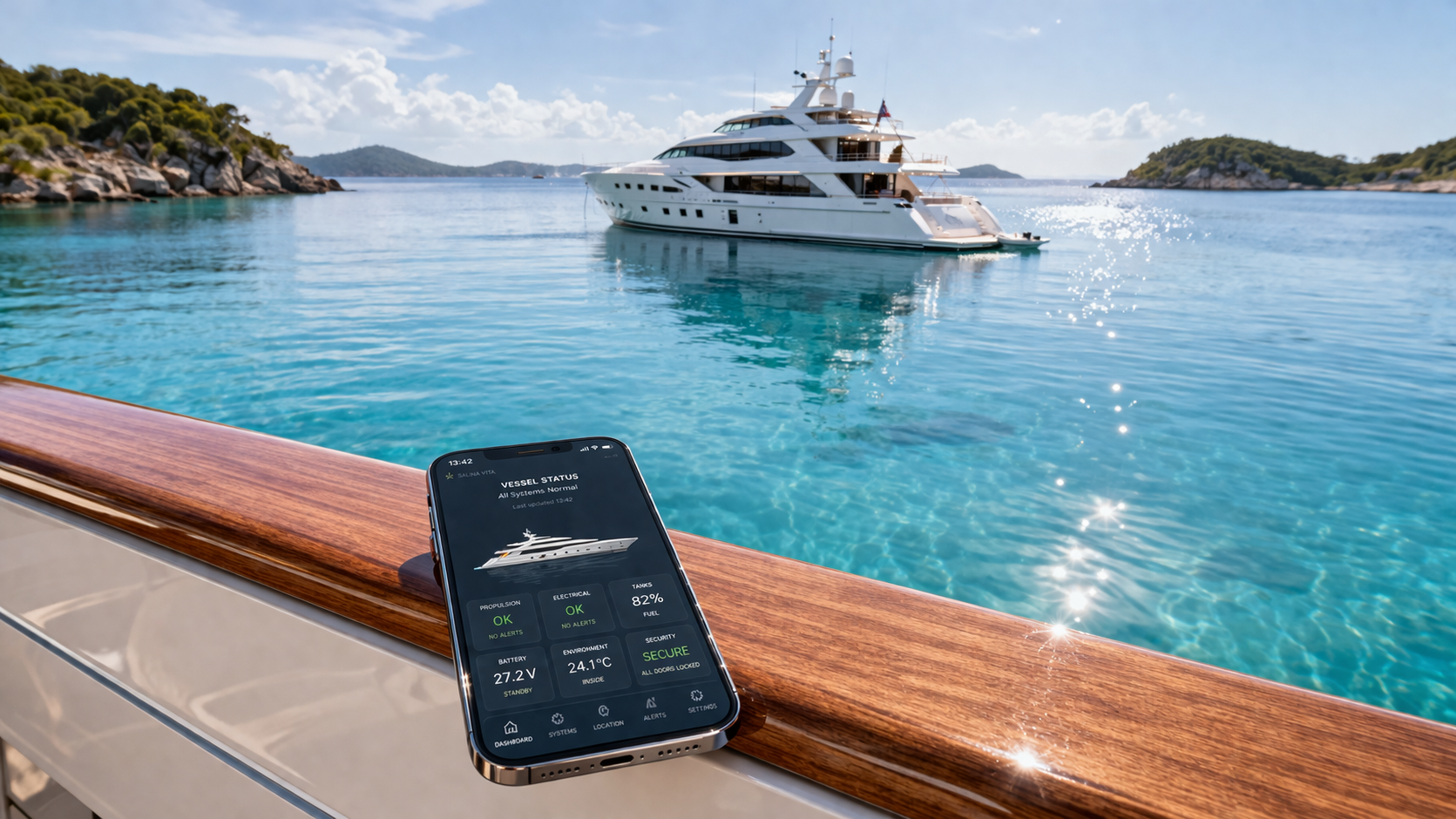
Garmin’s Cortex materials describe Cortex Monitor Premium as unlocking real-time vessel status, instant alerts, and device control, while smartAIS Anchor Watch uses the vessel’s position and heading to determine whether the anchor is dragging. Garmin says that if the boat moves outside the anchor swing radius, alarms can sound on Cortex handsets, a connected speaker, and a smartphone, with alerts delivered ashore through the Cortex Monitor app. The same product overview also lists geofence location alarms and built-in or external monitoring for battery voltage, boat position, bilge level, bilge-pump cycles, water depth, security, and additional sensors. (Garmin)
That distinction matters because a yacht at anchor is rarely at risk from one thing only. A dragging anchor, an unexpected bilge event, a low-voltage condition, or a security breach can all turn a relaxed shore excursion into an urgent return. A proper mothership-monitoring layer keeps those variables inside a system rather than scattering them across separate devices and assumptions. That is an operational inference from the monitoring capabilities Garmin documents. (Garmin)
Garmin’s Vesper catalogue adds an important nuance: smartAIS Anchor Watch is described as “much more than just a geofence alarm.” The company says it uses the actual anchor position from the bow, accounts for scope and depth, and can alert on board or off the boat via the Cortex Monitor app. The same materials describe bread crumbs that track the boat’s movement at anchor over time, which helps the operator understand true swing behavior and adjust the anchor position if needed. In practice, that is a more sophisticated answer than simply drawing a circle around a GPS point and hoping it is good enough.
Traffic awareness still matters inside a quiet anchorage
The second layer begins once the mothership is secure: understanding what is moving around it.
Raymarine’s AIS guide notes that AIS data can be displayed on both chart and radar screens, and that each target can provide details including name, position, COG, SOG, CPA, and TCPA. Raymarine also says a threatening AIS target turns red and can trigger an alarm based on criteria set by the operator, such as a target coming within a specified distance inside a specified time window. It further notes that knowing the identity of a target is especially valuable if the operator wants to call that vessel on VHF. (Raymarine)
That is especially relevant when the tender is returning through a busy cut, a fuel dock approach, or a crowded anchorage at blue hour. The yacht’s electronics should not merely show that something is moving nearby; they should help the person on the mothership decide whether the contact is material, how close it will come, and whether it needs to be called by name. AIS becomes less about “seeing ships” and more about compressing decision time when the tender, the mothership, and surrounding traffic all share the same small water. That is an inference from the CPA/TCPA, alarm, and identity features Raymarine describes. (Raymarine)
There is also an important limitation that sophisticated owners should keep in mind. Raymarine warns that it is easy to focus on AIS targets and forget that other vessels may not be transmitting AIS at all. In other words, AIS is a powerful layer of awareness, but it is not a substitute for watchkeeping, tender discipline, or visual seamanship in tight water. That warning matters in private anchorages, where smaller local craft or lightly equipped tenders may not appear on screen at all. (Raymarine)
Communication should sit inside the same decision loop
Traffic awareness is useful only if the yacht can act on it quickly.
Garmin’s Cortex Hub installation guide says the hub is an AIS Class-B SO-TDMA transponder with integrated on-board and remote vessel monitoring and control, and that when paired with a Cortex H1 or H1P portable handset, it becomes a fully featured 25W VHF radio with Class D DSC functionality. Garmin also says the hub shares AIS data over NMEA 2000, NMEA 0183, and Wi‑Fi, which is exactly what allows the communications layer to live inside the broader helm and monitoring environment instead of standing apart from it.
Garmin’s Cortex handset quick-start guide shows the practical benefit of that integration. It says operators can view AIS targets with smartAIS filtering, identify the target with the highest risk of collision, and select a vessel to make a direct DSC call. The same guide notes that the target display includes name, range, bearing, and target vectors. That means the transition from seeing a target to contacting it can be shortened dramatically, which is exactly the kind of quiet efficiency that matters when the tender is rejoining the yacht or when another vessel is entering the anchorage too aggressively.
Garmin support also notes that the Cortex Onboard app can control the Vesper VHF, hailer, and horn functions. That is not a tender-tracking feature in itself, but it does reinforce a broader point: on a premium yacht, communication should not be trapped at one physical station if operations are unfolding at the transom, on the side deck, or around the swim platform while the tender is being launched or recovered. (Garmin Support)
Guest safety is not only a collision problem
A refined tender-safety strategy should also account for what happens between the yacht and the water.
Garmin’s Vesper catalogue says smartAIS can monitor for Man Overboard activations and sound an audible alarm, either through a dedicated MOB button or when receiving a signal from an activated AIS-equipped MOB beacon. That is a valuable reminder that the tender layer is not only about route awareness and communications. On some yachts, especially those that anchor for swimming, beach transfers, or low-light returns, a personal MOB layer may be a rational addition for crew or guests moving repeatedly between the mothership, the tender, and the water.
Garmin’s Cortex materials also emphasize that the remote-monitoring layer extends beyond position alone. The product overview and installation guide describe monitoring for battery voltage, barometric pressure, bilge level, bilge-pump cycles, water depth, shore power, and vessel security, with remote alerts delivered by smartphone. For an owner or captain who has gone ashore while the yacht remains at anchor, that means the electronics can keep watching the vessel’s essentials instead of relying on periodic manual checks. (Garmin)
What we would recommend at Salina Vita
For a yacht that regularly sends the tender ashore from remote anchorages, we would not treat safety as a single-product purchase. We would build it in layers.
First, the mothership should have a serious anchor-watch and remote-monitoring layer: anchor-drag logic that accounts for real anchor position and scope, plus geofence and essential systems monitoring. Second, the yacht should have a traffic-awareness layer that makes nearby contacts legible through AIS, CPA/TCPA logic, and VHF-ready identity. Third, the communications layer should be integrated enough that the crew can move quickly from seeing a developing situation to responding through DSC or VHF. And where the owner’s use pattern warrants it, a personal MOB layer can add another level of protection during frequent tender transfers or swim operations. That framework is an inference from the capabilities documented by Garmin and Raymarine, but it is the most coherent way to turn separate electronics into one quiet operating standard. (Garmin)
The goal is not to make a secluded anchorage feel more technical. The goal is to make it feel less fragile. When the tender leaves, the yacht should not become an unattended question mark. It should remain exactly what a well-specified mothership is meant to be: stable, supervised, and ready to receive its guests back without hurry. (Garmin)

Share:
Best Chartplotter Setup for Bahamas Anchorages
Yacht Remote Monitoring System for Remote Anchorages