
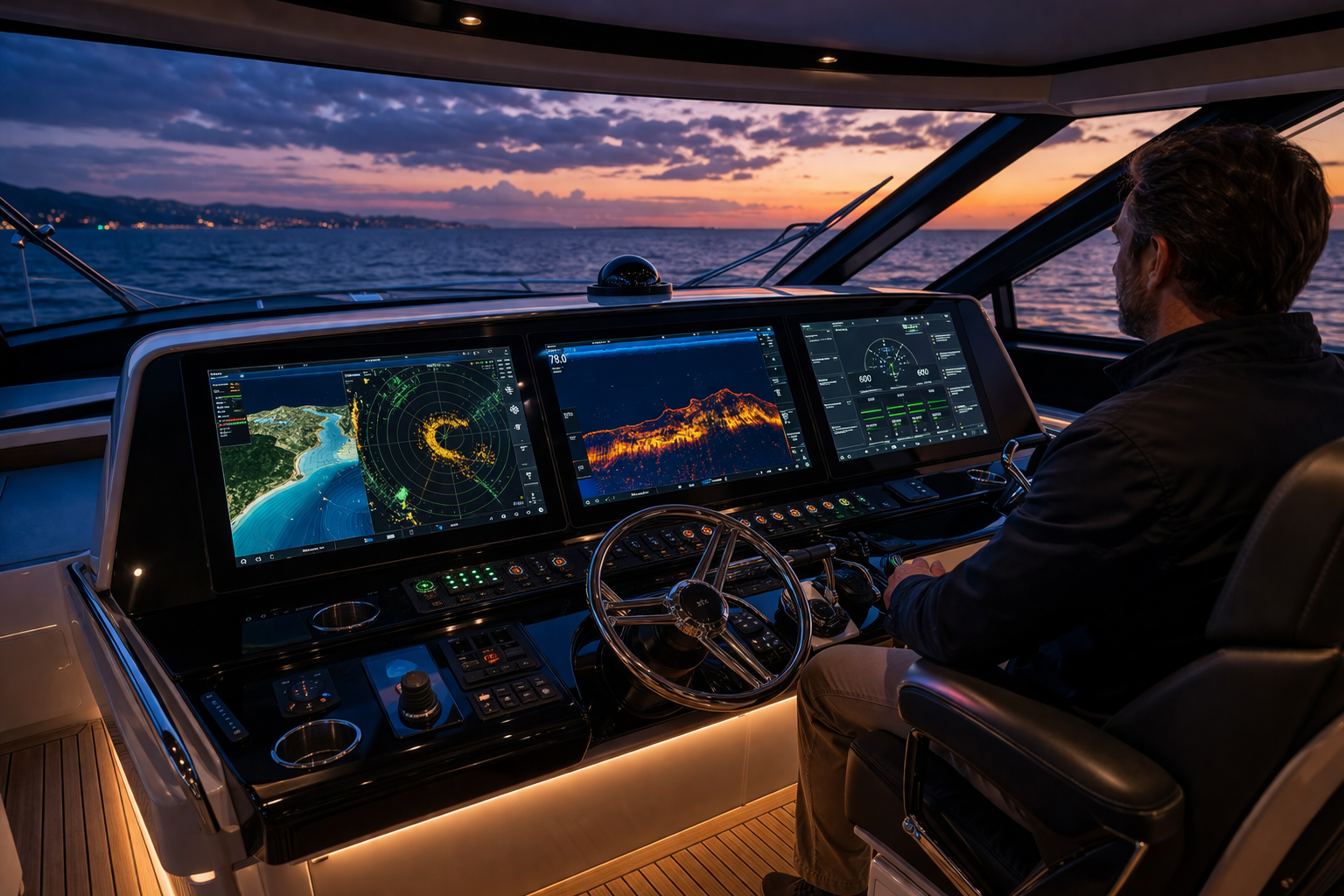
Built-In Sonar or Black-Box CHIRP? How Offshore Captains Should Spec Their Next Fishfinding System
Once a boat begins working real depth offshore, sonar stops being a feature and becomes an architecture problem.
That is the point where many buying decisions go sideways. Owners often compare screen size, interface design, or headline power numbers before they have decided what the system actually needs to do: separate game fish from bait, hold bottom cleanly in depth, reveal thermoclines, and keep useful detail on screen when the boat is moving, pitching, or working over uneven bottom. The right question is not which display looks most impressive at the dock. It is whether the sonar module, transducer, and helm architecture are matched to the way the boat is actually fished. Raymarine frames this directly in its CP470 offshore sonar positioning, emphasizing bait discrimination, thermocline identification, and reliable bottom tracking, while Furuno’s DFF3-UHD is pitched around clarity and depth performance for fish and structure at extreme range. (Raymarine)
Integrated sonar is better than many owners assume
For some offshore boats, especially those that want a cleaner helm and fewer hidden boxes, premium integrated sonar is already far more capable than older buyers may expect.
Raymarine’s Axiom 2 Pro RVM is a good example of how far integrated systems have moved. Raymarine positions it as an all-in-one fishing system combining chartplotter, fish finder, radar, autopilot, and video, and says the RealVision MAX versions include built-in CHIRP DownVision, SideVision, RealVision 3D, a 600-watt traditional CHIRP fish finder for coastal fishing, and a 1 kW dual-channel CHIRP fish finder for deep water. In practice, that means a serious captain can get meaningful coastal and offshore fishfinding capability without immediately stepping into a separate black-box sonar architecture. For the right hull and the right use case, integrated sonar is no longer the compromise it once was. (Raymarine)
That does not mean integrated sonar is always the best answer. It means the threshold for “good enough” has moved upward. If the priority is a clean glass helm, fewer components behind the dash, and a unified interface for navigation and fishing, a high-end integrated display may be the most elegant place to begin. That conclusion is an inference from Raymarine’s published system design and channel specifications, but it is a practical one: when one display can credibly cover DownVision, SideVision, 3D imaging, and 1 kW deep-water CHIRP, the decision to add a black-box module should be deliberate, not automatic. (Raymarine)
Black-box CHIRP earns its place when depth, control, and separation matter most
Once the boat’s mission becomes more demanding, dedicated black-box sonar starts to justify itself.
Raymarine’s CP470 is explicitly designed for offshore use and rough conditions. Raymarine says its 2 kW CHIRP sonar module uses wide-spectrum CHIRP technology, can see through dense schools of baitfish, identify thermoclines, and track the sea floor down to 10,000 feet with two adjustable CHIRP channels. It also supports low, medium, and high CHIRP transducers and lets the operator control each channel independently or combine them across split-screen layouts on LightHouse-powered displays. That matters because offshore captains are rarely asking a single sonar question at a time; they are trying to interpret multiple parts of the water column without surrendering bottom definition. (Raymarine)
Furuno’s DFF3-UHD sits even farther into that high-power offshore category. Furuno says the module delivers 2 kW or 3 kW of power to a compatible broadband transducer, transmits across low, medium, and high CHIRP ranges, and uses digital signal processing to interpret fish and structure with high clarity and resolution at depth scales down to 15,000 feet. Furuno also says the module is intended to improve target definition and maintain returns from bait balls and individual fish throughout the water column, even when fish are tightly schooled or close to the seafloor. For captains running deeper programs, hunting precise separation, or working larger sportfishing platforms, that is not a cosmetic jump in specification. It is a different class of sonar ambition. (Furu No USA)
As a planning framework rather than a manufacturer claim, this is the simplest distinction: integrated sonar is now strong enough for many offshore helms, but black-box CHIRP earns its place when the captain wants more authority over channel behavior, more transducer flexibility, and more confidence that deep-water detail will hold together under difficult conditions. Raymarine’s CP470 and Furuno’s DFF3-UHD support that interpretation because both are marketed around offshore depth, noise rejection, and serious target definition rather than general-purpose convenience. (Raymarine)
The transducer is not an accessory
Most weak sonar systems are not weak because the display is wrong. They are weak because the transducer was treated like an afterthought.
Raymarine’s B265 through-hull and TM265 transom-mount examples make that point well. Raymarine says the low element on both transducers can detect bottom and fish as deep as 3,000 meters, or 10,000 feet, and that they mate directly to Axiom Pro RVX, Axiom 2 Pro RVM, RVM-1600, CP470, CP570, and legacy CHIRP sonar modules. In the case of the B265, Raymarine also notes that the included fairing is intended to improve broadband performance at speeds above 30 knots. That is the kind of specification that matters offshore, because it shifts the conversation from “what display should I buy?” to “what transducer geometry and mounting method will preserve sonar quality on the hull I actually run?” (Raymarine)
Garmin’s GSD 28 installation guidance makes the same point from the opposite direction. Garmin says every boat is different and that the installation must be carefully planned. More importantly, its manual transducer configuration parameters include impedance, maximum transmit power, nominal frequency, whether CHIRP is enabled, and the lower and upper 3 dB frequency limits of the sweep. Garmin also warns that setting those parameters incorrectly can damage the transducer. That is one of the clearest reminders in the category that serious sonar performance is not created by “adding a module.” It is created by matching the module to the transducer correctly, wiring it correctly, and configuring it with technical discipline. (Garmin)
Offshore fishfinding is a system-design problem before it is a shopping problem
The best offshore sonar builds are specified in the same order every time: use case first, transducer path second, display strategy third.
Garmin’s GSD 28 manual explicitly begins with planning the mounting location, then connecting the sonar module to the transducer, power, and network. It also specifies practical installation requirements such as keeping the module out of submersion, providing adequate ventilation, routing cables correctly, and ensuring the module is mounted within reach of the transducer cable. Those are not glamorous details, but they are what separate a robust offshore system from a fragile one. A refined helm may hide the complexity, but it cannot avoid it. The deeper the boat is expected to perform, the less forgiving the installation becomes. (Garmin)
That is why the most intelligent offshore spec is not “What is the biggest module I can buy?” It is “What combination of display, module, and transducer gives me the cleanest interpretation of the water I actually fish?” For some boats, Raymarine’s Axiom 2 Pro RVM will already deliver the right balance of integrated helm simplicity and offshore capability. For others, a CP470-style black-box module becomes the better answer because it adds dual-channel flexibility and dedicated offshore CHIRP depth. And for the most demanding deep-water programs, Furuno’s DFF3-UHD becomes compelling precisely because it is engineered to push harder into power, DSP, and extreme depth scales. That breakdown is an inference from the published specifications, but it is a grounded one. (Raymarine)
What we would recommend at Salina Vita
If a captain asked us where to begin, we would not begin with brand loyalty. We would begin with the fishing profile.
How deep does the boat truly work? Is the priority bluewater trolling, bottom fishing, bait discrimination, or a more versatile mixed-use program? Does the helm need to stay visually clean, or is the boat already committed to a more modular electronics architecture? Is the transducer path already defined, or does that still need to be solved? Those questions matter more than retail comparison charts, because offshore sonar performance is cumulative. Display quality matters. Module power matters. CHIRP range matters. But transducer selection, installation discipline, and system matching are what determine whether all of that hardware becomes usable intelligence at sea. The manufacturer documentation from Raymarine, Furuno, and Garmin all points in the same direction: the serious conversation starts before checkout. (Raymarine)
A premium fishfinding system should do more than paint attractive color on a screen. It should reduce ambiguity, separate targets with confidence, and let the captain trust what the water is saying back. That is the difference between electronics that look expensive and electronics that earn their place offshore. (Raymarine)

Share:
Glass Bridge Upgrade for a 50-Foot Yacht
Starlink Maritime vs. KVH for Yachts