
How to Plan a Glass Bridge Upgrade for a 50-Foot Yacht Without Compromising the Helm
A proper glass-bridge refit is not a screen purchase. It is a systems decision.
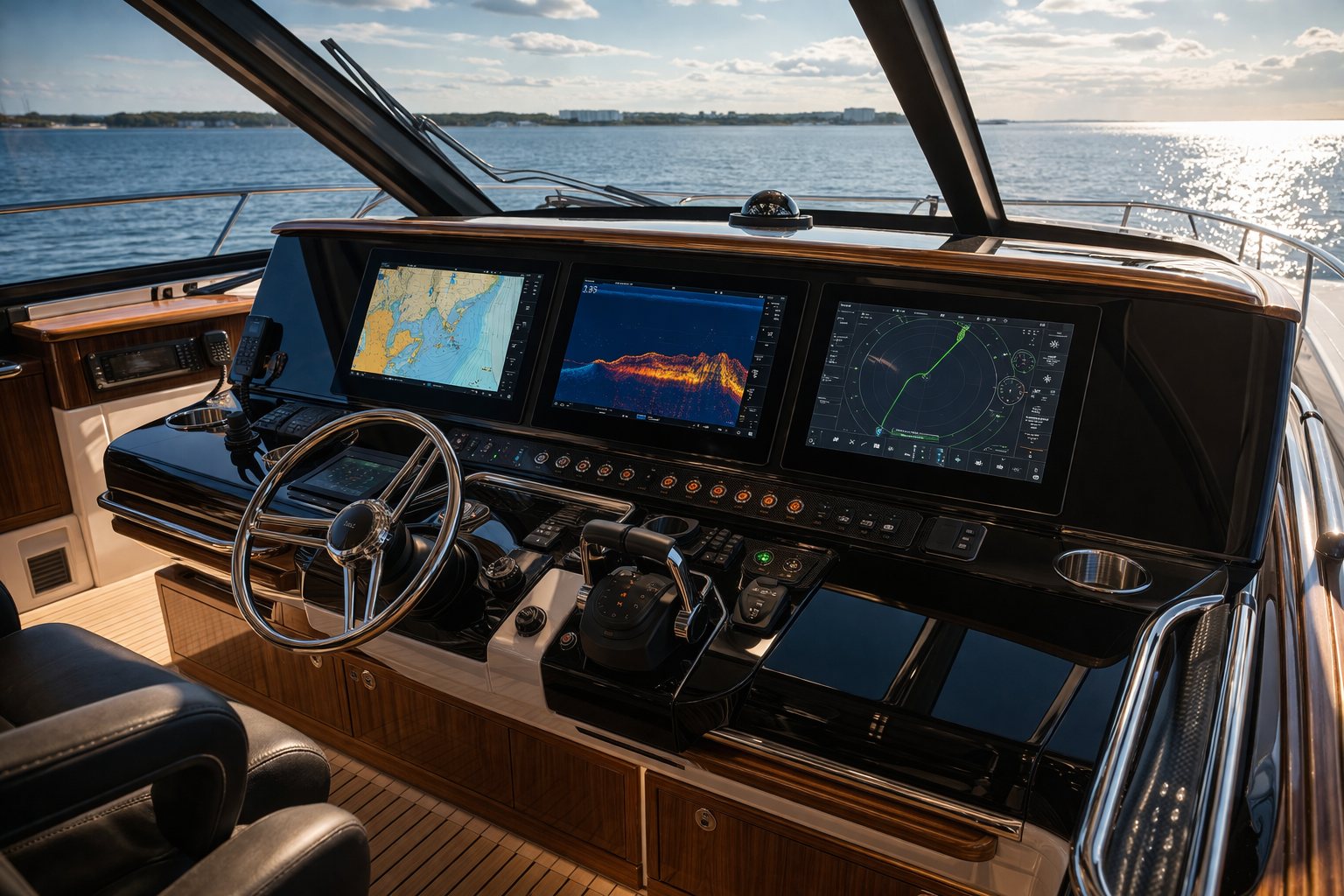
That distinction matters because the most expensive helm mistakes rarely come from choosing a weak display. They come from forcing new electronics into an old architecture, overloading the dash with mismatched hardware, or treating networking, control, and power as afterthoughts. On a 50-foot yacht, the helm has enough importance that every visible element and every hidden layer has to work together: charting, radar, autopilot, sonar, cameras, switching, and the physical design language of the bridge itself. That is what separates a modern glass bridge from a crowded retrofit. (Raymarine)
Start with the network, not the screen size
The most important line in a glass-bridge project is often the one no owner ever sees: the network diagram.
Garmin’s NMEA 2000 planning guidance is unusually direct. The backbone is the main communication channel of the network, every device connects to that backbone with a T-connector, the network must be powered correctly, and terminators must be installed at both ends. Garmin also advises starting with a detailed diagram that includes device locations, cable distances, overall backbone length, and each device’s LEN power consumption. In other words, if the network is improvised, the helm will be compromised no matter how beautiful the displays look after installation. (Garmin)
That is the first planning mistake Salina Vita would avoid. A refined helm should be designed around a deliberate data backbone, with display placement, sensor selection, and future expandability mapped before anyone cuts a panel. Luxury at the helm is not only visual restraint. It is the absence of friction when every system begins talking to every other system exactly as intended. That is an inference from Garmin’s network requirements, but it is the practical consequence of them. (Garmin)
Decide early: all-in-one helm or black-box architecture
The second major decision is structural. Do you want an all-in-one display-led helm, or a black-box-led helm built around remote processors and chosen monitors?
Raymarine’s Axiom 2 Pro S is a strong example of the all-in-one approach. Raymarine says it gives you HybridTouch control with reliable keypad input when seas are rough, and that two RayNet Ethernet ports plus NMEA2000 allow multiple Axiom displays, fish-finder modules, marine radar, autopilot, thermal, and video cameras to operate as part of one system. That makes it attractive for owners who want a premium, integrated helm with fewer architectural decisions hidden behind the dash. (Raymarine)
Black-box systems solve a different problem. Furuno’s TZTBBX is explicitly positioned as a helm-tailoring product: display supplied separately, with support for radar, high-powered fish finders, AIS, autopilot, and deep-water multibeam sonar. Furuno’s launch material adds that the TZTBBX supports up to a six-way split window on virtually any display size you choose, including 17-inch, 19-inch, and 24-inch multi-touch displays. That is not just a feature list. It is a design philosophy: hide the processor, choose the display geometry intentionally, and let the helm read as a composed surface rather than a collection of boxes. (Furu No USA)
Garmin’s GPSMAP 9500 Black Box sits in the same architectural category. Garmin’s install guidance says a third-party touchscreen monitor connects over HDMI for video and USB for touch input; if the chosen monitor is not touchscreen, Garmin recommends adding a GRID or GRID 20 remote so the operator can still control the chartplotter. Garmin also notes that the GPSMAP 9500’s network ports act as a Garmin BlueNet switch, and that legacy Garmin Marine Network devices can be bridged in with a BlueNet 30 gateway. For a refit project, that is highly relevant: it means black-box Garmin can support a cleaner dash surface while still accommodating network growth and mixed-generation Garmin environments. (Garmin)
Protect the helm’s symmetry and sight lines
Once the architecture is defined, the design question becomes more disciplined: what actually deserves space on the main visual plane of the helm?
Furuno’s TZtouchXL line is useful here because the company markets the 16-inch, 22-inch, and 24-inch models as wide, all-glass displays that enhance both functionality and the style of the helm, while the 10-inch and 13-inch models lean into hybrid controls for conditions where tactile input matters. That product split tells you something important about helm design: not every display belongs in the primary visual zone, and not every function should depend on pure touch. (Furu No USA)
For many 50-foot-yacht refits, the cleanest answer is a hierarchy, not a wall of identical screens. The primary visual zone should handle the data the captain interprets continuously — chart, radar, route, traffic, and the most important engine or situational overlays. Secondary displays or remote-control zones can manage deeper sonar pages, cameras, trip data, or system controls. That is a design recommendation, not a manufacturer spec, but it follows directly from the way Raymarine, Furuno, and Garmin each separate display, control, and network roles across their premium systems. (Raymarine)
The hidden layer matters more than most owners realize
The least glamorous part of a glass-bridge project is usually the part that determines whether it ages well.
Garmin’s GPSMAP 9500 installation instructions state that the unit should be mounted where it will not be submerged, where it has adequate ventilation, at least 1 inch from cables and other sources of interference, and in a location that leaves room for cable routing and connection. Garmin also advises that the power and ground connections be secured properly, that the power be routed through ignition or another manual switch, and that the NMEA 2000 network itself be switched rather than tied directly to the battery to avoid battery drain. (Garmin)
That is why a true helm refit cannot be judged by the front panel alone. Clean bezels and flush glass are the visible result of decisions made behind the surface: ventilation, service access, wire separation, grounding, switch logic, and how gracefully the system can be expanded later. When those details are neglected, a premium helm can still look expensive while behaving like a compromise. When they are handled correctly, the helm feels quieter, faster, and more legible because the hidden structure is no longer fighting the visible one. That is an inference from Garmin’s install requirements and the system architecture described by Raymarine and Furuno. (Garmin)
Plan the refit around use case, not aspiration alone
A 50-foot yacht used for coastal cruising, Bahamas crossings, and evening returns does not need to be specified the same way as a 50-foot sportfishing platform.
Raymarine positions Axiom 2 Pro as a multi-display navigation system that can incorporate radar, autopilot, thermal, and video, which makes it particularly strong when the owner wants an elegant, integrated command environment. Furuno positions TZtouchXL and TZTBBX around captain-tailored helms, Doppler radar, high-powered fish-finder options, and even deep-water multibeam sonar, which makes the platform especially compelling for serious offshore and sportfishing use cases. Garmin’s black-box approach is strongest when the goal is to preserve a clean dash design while integrating external monitors, BlueNet networking, and remote control around a custom helm concept. None of those are mutually exclusive value systems; they simply reflect different priorities in how a vessel is run. (Raymarine)
That is why the best refit conversations begin with operating profile, not brand preference. How the boat is actually used determines whether the helm should privilege radar awareness, fish-finder depth and target separation, video integration, simplified control under way, or the cleanest possible bridge aesthetics. The right answer is rarely whichever product has the longest feature list. It is the architecture that best matches the owner’s use pattern without overcomplicating the helm. (Raymarine)
The planning sequence we recommend
If we were scoping a glass-bridge upgrade for a client, the sequence would be straightforward.
First, map the vessel’s existing and future network: radar, autopilot, sonar modules, AIS, cameras, engine data, and control devices. Second, decide whether the helm should be built around all-in-one displays, a black-box processor, or a hybrid of both. Third, determine which functions deserve primary visual placement and which can live in secondary or hidden zones. Fourth, design the hidden architecture — power, ventilation, grounding, switching, cable routing, and service access — before committing to cutouts and finishes. Finally, build the package around the vessel’s real operating profile, not around the temptation to max out every spec category. That sequence is not copied from a single manufacturer document, but it is the clearest synthesis of the installation and system guidance published by Garmin, Raymarine, and Furuno. (Garmin)
A glass bridge should make the helm feel calmer, not busier. More capable, not more crowded. More intentional, not more electronic.
That is the standard Salina Vita is built around. We do not believe a premium helm begins with a product page. We believe it begins with a plan.
Share:
Thermal Camera vs. Radar for Yacht Night Navigation
Built-In Sonar or Black-Box CHIRP? Offshore Fishfinding Guide