Thermal Camera vs. Radar for Yacht Night Navigation: What Advanced Helms Actually Rely On
Night navigation is rarely difficult because the water is dark. It is difficult because the cues that normally make decisions easy begin to disappear at exactly the moment the consequences become more expensive. Spray, glare, haze, city lights, and unlit objects all change what the helm can interpret, and offshore the absence of ambient light can make small hazards harder to spot than many owners expect. (FLIR Marine)
That is why serious helms do not treat night vision as a novelty feature. They treat it as an awareness problem. The real question is not whether radar is “better” than thermal, or vice versa. The question is which system gives you the right information first, and which one closes the gap between detection and identification when the margin for error narrows. (Garmin)
Radar still matters because position matters
Radar remains foundational because it integrates directly into the navigation environment of the helm. Garmin notes that when radar overlay is used, the chartplotter aligns radar data to chart data using boat heading, and that heading is ideally supplied by a magnetic heading sensor over NMEA 0183 or NMEA 2000. If no heading sensor is available, the system can fall back to GPS tracking data instead, which reflects where the boat is moving rather than where it is actually pointing. In current, wind, or drift, that distinction matters because the overlay may no longer align cleanly with the chart. (Garmin)
That is a more important technical detail than it first appears. A premium night-navigation setup is not just “radar on the boat.” It is radar with dependable heading data, stable overlay behavior, and an MFD environment that lets the captain interpret returns quickly. The practical advantage of radar is that it adds structured spatial context around the vessel. The limitation is that a return still has to be interpreted correctly. That final point is an inference from Garmin’s overlay guidance rather than an explicit manufacturer claim, but it is exactly where many night passages are won or lost. (Garmin)
Thermal matters because identification matters
Thermal earns its place for a different reason. FLIR’s current night-vision guidance says thermal imaging works independently of visible light, remains effective in complete darkness, is less affected by glare, and can see through smoke, haze, dust, and some fog conditions. In other words, thermal does not depend on the quality of the available light the way image-intensified and ultra-low-light systems do. (FLIR Marine)
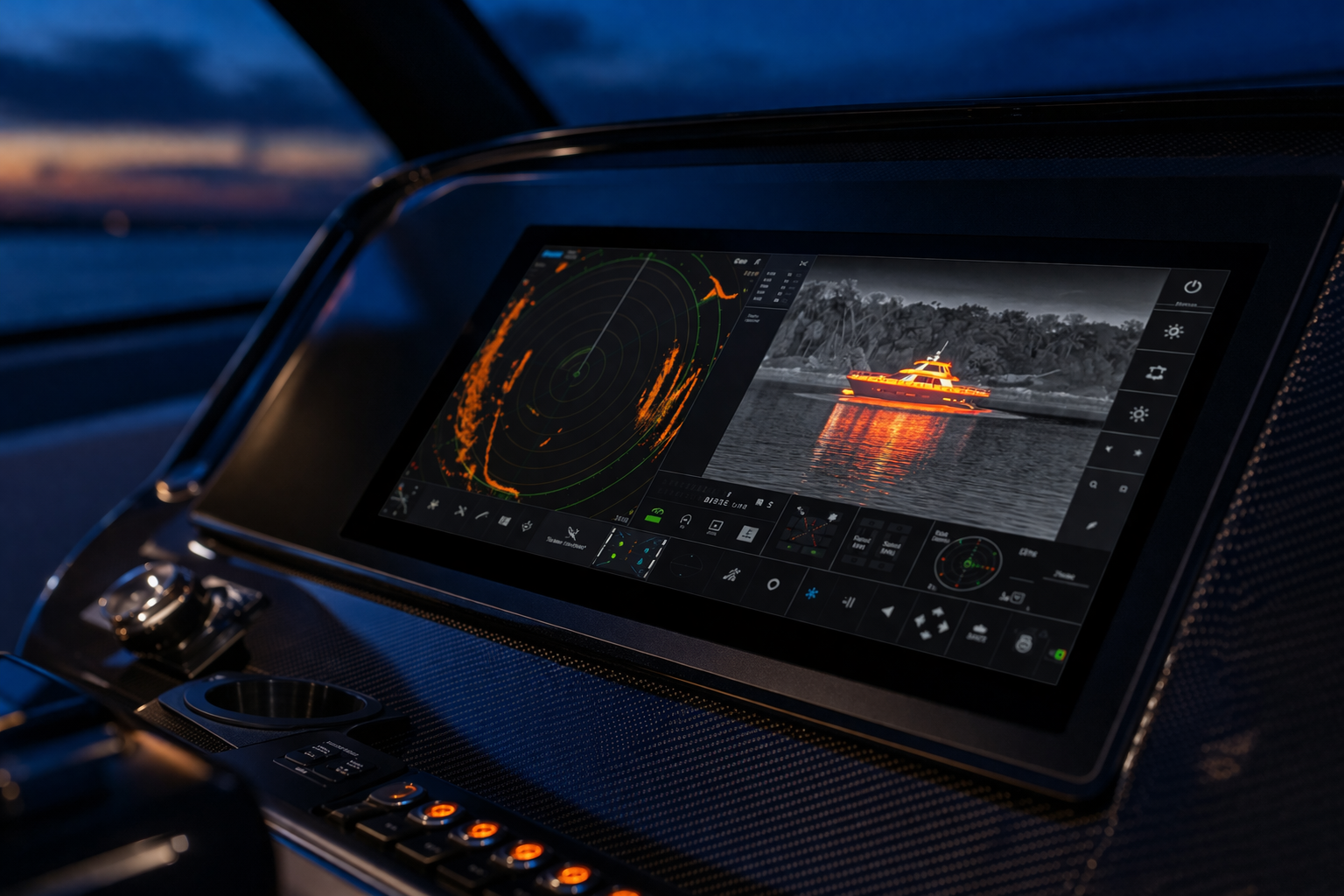
That distinction becomes valuable the moment a captain needs to answer a different question than radar is asking. Radar may confirm that something is ahead; thermal is often what helps determine whether that target is a vessel, a buoy, floating debris, or shoreline clutter. FLIR’s own M364C page is unusually clear on this point: the camera combines a high-resolution thermal core with an ultra-low-light visible camera, uses Color Thermal Vision to blend the two, and is designed for positive identification of buoys and other vessels. It also uses 2-axis stabilization to keep the image steadier in rough water. (FLIR Marine)
FLIR makes the same argument more broadly in its maritime-learning material, noting that thermal cameras detect heat signatures of people and vessels in total darkness and can help operators avoid floating debris, docks, pilings, land, and anchored vessels at night. That is not a stylistic benefit. It is operational clarity. (FLIR Marine)
The real answer for a serious yacht is usually both
On a refined helm, the smartest answer is rarely “replace radar with thermal.” It is to build a layered awareness stack where radar contributes structured range and chart context while thermal shortens the time between detection and visual understanding. That is an inference from the capabilities described by Garmin and FLIR, but it is also the logic behind how premium MFD ecosystems are now being built. (Garmin)
Raymarine’s Axiom 2 Pro S is a good example of that direction. Raymarine describes it as an all-in-one system that combines chartplotter, sonar, radar, autopilot, and video, and notes that it can operate as a single display or as part of a multi-display system over RayNet. It also supports NMEA 2000 integration, which is the kind of network architecture that matters once a helm moves beyond a single screen and into a true command environment. (Raymarine)
Raymarine also highlights two details that matter more at night than many spec sheets suggest: HybridTouch control, which gives a captain both touchscreen and keypad interaction in rough conditions, and smart backlighting with an ambient light sensor that adjusts brightness for day and evening. That may sound minor in a showroom. At blue hour, in chop, with a dimmed bridge and wet fingers, it is not minor at all. (Raymarine)
Not every camera belongs on every helm
There is also a genuine difference between entry-level thermal and upper-tier multispectral systems. FLIR’s M232 is positioned as a compact pan/tilt thermal camera with 320 x 240 resolution, video over IP, and chartplotter control; FLIR says it helps boaters see bridges, docks, buoys, and other vessels in total darkness, and can help find people in the water faster than spotlights and radar alone. That makes it a credible fit for owners who want a more accessible thermal layer without redesigning the helm architecture around a larger, more advanced camera. (FLIR Marine)
The M364C sits higher in the hierarchy. FLIR describes it as a multispectral system with a high-resolution thermal core, ultra-low-light visible camera, Color Thermal Vision, and 2-axis stabilization. For a larger yacht, a more demanding coastal profile, or a captain who values positive target identification rather than simple heat detection, that is a materially different class of tool. (FLIR Marine)
Where most night-navigation systems actually fail
The mistake is usually not the hardware. It is the architecture around it.
A sophisticated night-navigation package depends on clean network logic, not just good individual products. Garmin’s overlay guidance makes clear that heading source integrity affects radar alignment, and Raymarine’s Axiom 2 Pro documentation makes clear that radar, autopilot, thermal, and video are designed to operate as parts of a larger networked system over RayNet and NMEA 2000. The lesson is straightforward: a premium helm should be specified as a system, not assembled as isolated boxes. (Garmin)
That is also why “big screen plus add-ons” is not the same thing as a glass bridge. A real glass-bridge approach considers display placement, sight lines, heading source, network topology, keypad access, low-light brightness behavior, and which data layers belong on which screen during night operation. The hardware may be beautiful, but beauty is not the outcome. Reduced interpretation time is. That final sentence is an operational inference, but it follows directly from the manufacturer-described integration features above. (Garmin)
What we would recommend at Salina Vita
For a yacht owner or captain running late returns, inlet entries, or evening coastal passages, the best specification path is usually fit-led rather than brand-led. A compact thermal camera may be enough when the goal is to add a clean awareness layer to an already capable radar helm. A stabilized multispectral camera becomes more compelling when the vessel is larger, the runs are longer, or the owner wants more confidence identifying targets in mixed light and rough water. In nearly every serious use case, the better result comes from pairing thermal with a well-integrated radar-and-MFD environment rather than trying to make one technology carry the entire burden. That is our inference from the capabilities Garmin, FLIR, and Raymarine describe. (FLIR Marine)
The quiet luxury of a great helm is that it reduces drama before drama begins. Night navigation is one of the clearest examples. The right system does not simply show more data. It lets the captain understand the scene ahead faster, with less ambiguity, and with fewer compromises between awareness and control. (FLIR Marine)
Share:
Glass Bridge Upgrade for a 50-Foot Yacht